lunes, 15 de abril de 2013

The Roman Hispania.

Let's move into our HISTORY TIMELINE. This time we are going to learn about ROMAN HISPANIA. It is said when the Iberian Peninsula was inhabited by the Romans.


This video will show you the life on Roman Times by a 10 year-old children:


A big part of Europe was inhabited by the Romans during this time. It was the Great Roman Empire.


In 218 B.C.Romans defated the Carthaginians in a war, so they started to control de Mediterranean Sea. They Completed the conquest of the Iberian Península in 19 B.C. Because of the resistance of people in the interior. 

ROMAN RULE:
  • The peninsula became a part of the Roman Empire. It was called Hispania.
  • Inhabitans adopted Roman customs, and they were ruled by Roman law.
  • They spoke Latin.
  • The governor was a Roman person. 
  • The Iberian leaders became the Roman Aristocratic class, and part of the goverment. 

END OF THE ROMAN RULE:
After about 400 A.D. Germanic tribes from the central and northern Europe invaded Hispania and conquered the Territory. The Roman lost the control of the peninsula. 

Romans were very good at Architecture, transport and communication. They constructed:
  • Triumphal arches and columns were built to commemorate important events such as victory in a battle. 

  • Ports, bridges and aqueducts were built to improve life in the cities. 

  • Romans also built stones roads between cities of the peninsula and between Hispania and other parts of the Empire. 

LET'S TAKE PART ON THIS QUIZZ AND CHECK WHAT YOU HAVE LEARNT.

miércoles, 10 de abril de 2013

Pre-Roman Times

When we talk about pre-Roman Times we are speaking about all the time which goes from the Prehistory to the Roman Empire in the Iberian Península. 

During this time in the Iberian Peninsula there were different groups of inhabitants: The Celts, The Iberians, The tartessians, The Phoenicians, The Greeks and The Cartaginians.

With this video you will understand better the beggining of this period, Let's have a look to the history of the Celts. 


The Iberians: they lived in the east and south of Spain. They were warriors, herders, farmers, craftsmen, merchants and slaves.

The Celts stayed in Spain in the north and the centre. Their tribes were divided into family clans. They were herders and farmers. They were also expert metalworkers, they made jewellery, weapons and tools.

Celts and Iberians mixed to form the Celtiberians. 

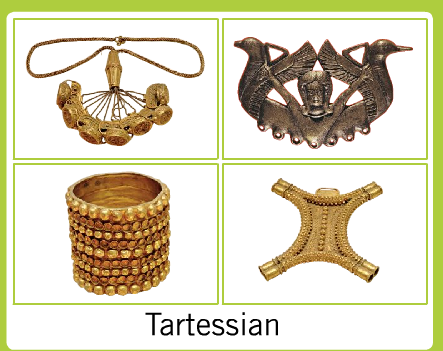
The Tartessians lived in the Guadalquivir valley (It was rich in metals: gold, silver and copper). They were great travellers and expert metalworkers and salt producers. 

The Phoenicians were traders from Asia. They were settled on the south coast. They founded Gades (Cadiz). Thay became important trading partners of the Tartessians. 

The Greeks settled on the Mediterranean coast. They came to trade ceramic objects for metals. They founded the city of Denia. 


The Carthaginians came from the North Africa to trade metals and cloth. They also settled on the Mediterranean coast and founded the city of Cartagena. 


All of this colonising civilisations left culturan legacies, such as the alphabet and metal coins. 

Ver Pre-Roman Times en un mapa más grande

LET'S PLAY AND REVIEW ALL YOUR KNOWLEDGE ABOUT THE PRE-ROMAN TIMES. 

lunes, 8 de abril de 2013

Prehistory in the Iberian Peninsula.

We are going to learn about another topic of Science, from this moment to the end of the school year we are going to focus our lesson on the HISTORY OF SPAIN. To learn history is very important because this will be the way you will understand most of the things that are taking place now.

LET'S HAVE A LOOK TO THESE PHOTOS AND ANSWER THE QUESTIONS:


  • What can you see in the two pictures?
  • What are these things made of?
  • Which ones were made first?
THE FOLLOWING VIDEO WILL HELP YOU TO UNDERSTAND THE LIFE IN THE PREHISTORY PERIOD. 


PALEOLITIC PERIOD:


  • Million years ago, Iberian Peninsula was inhabited by homids or early humans beings. Modern people appeared in Spain about 35.000 years ago.
  • They were nomads, they moved from place to place.
  • They lived in caves or huts.
  • They lived in family groups called clans.
  • They obtained their food hunting, fishing and gathering plants. 
NEOLITIC PERIOD:


  • People became sedentary. They built settlements.
  • People lived in tribes, they were larger than clans.
  • Each member of the tribe had a specific job  (cultivating th land, looking after animals, making tools or weapons)
THE METAL AGES:

  • They used metals for weapons and tools.
  • Settlements became villages, with walls for protections.
  • Every village was run by a chieftain
PREHISTORY HERITAGE:
Prehistory people were the first:
  • To use fires to cook and protect themselves from the cold.
  • To make clay pots.
  • To use animal hair and looms to make cloths.
  • Create art forms such as cave paintings. 
LET'S REVIEW WHAT YOU HAVE LEARNT WITH THIS ACTIVITY. 


If you want to learn a bit more about PREHISTORY, you will play to this game about PREHISTORY ANIMALS.