Along this month we are going to start a new project for Year 1 at Colegio San Gregorio. It is titled: My Augmented Zoo, the final product will be a big poster in which the students will talk about their animals.
To start with we are going to start learning about things, and the characteristics of Living and Non-living things. Let's enjoy the following song and discover the three main characteristics of each group of things:
When we discover the three main characteristics we will try to use our ideas in different things classifying into groups the given flashcards, we will give reasons for each one.
In the following worksheet we are going to show our learning along this lesson.
Along this topic we have learn about the living things and the cells. Today we want to learn a bit more about the organization of cells. If we focus our attention in the cells we can classify the organisms into MULTICELLULAR and UNICELLULAR.
Let's have a look to this video and at the end of the video in the group you have to create a definition about what a multicellular and an unicellurar is.
Living things that are composed of two or more cells are called multicellular organism. All the cells are arranged so that the organism can performed the vital functions.
LEVEL 1: It is the single cell.
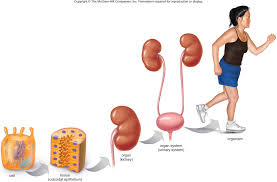
LEVEL 2: Tissues. They are a set of one type of cells which performs the same function.
LEVEL 3: Organs. The grouping together of a set of tissues which performs the same function.
LEVEL 4: System. Some organs that perform the same function are grouped together in a same system.
All the systems perform the ORGANISMS
Let's practise a bit more about Organization of Living Things using this video and the following test.
Muscle cellsare elongated. These cells and the tissues can expand and contract. This allows muscle to move.
Epithelial cells: These flat cells line certein area of the body such all the skin. They insulated the body and protect it.
Nerves cells: They are star shaped with long extension or arms. These cells establish connections and then transmit information to all parts of the body
To sum up and internalise your knowledge along this lesson you are going to create a model explaining from the cells to the organism. Let's use plasticine to create the model and paper to label it. Take a picture of it to publish it.
What do you have to do? Create a model using plasticine and paper to reproduce this photo.
STEP 1: Decide with your mates what you are going to represent. Let's investigate how it is and how to represent.
STEP 2: Talk with your mates about the material you will need and how do you will organize to have it (plasticine, sticks, papers, and if it is posible a camera to take a photo)
STEP 3: Organize the group deciding who is going to do each things, who is going to create the cell, who the tissue, the organ,.....
STEP 4: Work on your part of the task, don't hesitate to ask for help to your mates in case it is necesary.
STEP 5: Let's prepare the final model and take a picture and send it to your teacher.
STEP 6: Each group will show the final product to the rest of the groups.
It will be esier for you to talk in front of your mates if you have a script to follow. The following sentences would be helpful for you.
Hello, we are........
We are going to present you the .......levels of organization of the human body.
The first level is the ......................
All the .............together form the 2nd level which is..................
The ............... together form the 3rd level which is the..............
The ................., ..........................., .......................... are the different organs for the .......................... system. Explain you system, you can use your own information or you can have a look to page 14 and 15 of your book.
The ...................... system with the ...................system, the ............system, the ... system, the ... system and the .............................system form the HUMAN BODY.
We are learning about living things. In the last lessons we were talking about The Characteristics of Living Things. Just take three minutes to remind and share your learning with your group mates and your class.
Now we are going to take a step forward in the organization of living things we are going to learn about the smallest part in a living thing. Do you know what it is?
All living things are made of cell. Cell is the samllest unit of live. It is a living thing because it performs the three vital functions: nutrition, interaction and reproduction.
Let's have a look to the following video and try to answer these questions:
What parts of the cell do you hear at the song?
What are the function of these parts?
Are there any diffeence between an animal cell and the plant cell?
All the cells have:
Nucleus: contains the material necessary to reproduce the cell and to assign the activities of the cell.
Cytoplasm: is inside the cell, It is a viscous liquid qich the organelles float in.
Organelles: perform various cell funtions, such us manufacturing chemicals and obtaining energy.
Cell membrane is the outer shell of the cell and takes part in the interaction fuction.
The plant cells have:
Cell wall: is a rigid structures that surrounds the cell membrane and protects the cell.
Chloroplast: are green organelles that capture light and produce nutrients.
LET'S INVESTIGATE: why do the plant cells have chloroplast?
Now it is time to fix your learning in your notebook. Let's draw the two cells, plant and animal ones, label them and write down the differences between them.
Along this topic we have learn about the living things and the cells. Today we want to learn a bit more about the organization of cells. If we focus our attention in the cells we can classify the organisms into MULTICELLULAR and UNICELLULAR.
Let's have a look to this video and at the end of the video in the group you have to create a definition about what a multicellular and an unicellurar is.
Living things that are composed of two or more cells are called multicellular organism. All the cells are arranged so that the organism can performed the vital functions.
LEVEL 1: It is the single cell.
LEVEL 2: Tissues. They are a set of one type of cells which performs the same function.
LEVEL 3: Organs. The grouping together of a set of tissues which performs the same function.
LEVEL 4: System. Some organs that perform the same function are grouped together in a same system.
All the systems perform the ORGANISMS
Let's practise a bit more about Organization of Living Things using this video and the following test.
Muscle cellsare elongated. These cells and the tissues can expand and contract. This allows muscle to move.
Epithelial cells: These flat cells line certein area of the body such all the skin. They insulated the body and protect it.
Nerves cells: They are star shaped with long extension or arms. These cells establish connections and then transmit information to all parts of the body
To sum up and internalise your knowledge along this lesson you are going to create a model explaining from the cells to the organism. Let's use plasticine to create the model and paper to label it. Take a picture of it to publish it.
What do you have to do? Create a model using plasticine and paper to reproduce this photo.
STEP 1: Decide with your mates what you are going to represent. Let's investigate how it is and how to represent.
STEP 2: Talk with your mates about the material you will need and how do you will organize to have it (plasticine, sticks, papers, and if it is posible a camera to take a photo)
STEP 3: Organize the group deciding who is going to do each things, who is going to create the cell, who the tissue, the organ,.....
STEP 4: Work on your part of the task, don't hesitate to ask for help to your mates in case it is necesary.
STEP 5: Let's prepare the final model and take a picture and send it to your teacher.
STEP 6: Each group will show the final product to the rest of the groups.
We are learning about living things. In the last lessons we were talking about The Characteristics of Living Things. Just take three minutes to remind and share your learning with your group mates and your class.
Now we are going to take a step forward in the organization of living things we are going to learn about the smallest part in a living thing. Do you know what it is?
All living things are made of cell. Cell is the samllest unit of live. It is a living thing because it performs the three vital functions: nutrition, interaction and reproduction.
Let's have a look to the following video and try to answer these questions:
What parts of the cell do you hear at the song?
What are the function of these parts?
Are there any diffeence between an animal cell and the plant cell?
All the cells have:
Nucleus: contains the material necessary to reproduce the cell and to assign the activities of the cell.
Cytoplasm: is inside the cell, It is a viscous liquid qich the organelles float in.
Organelles: perform various cell funtions, such us manufacturing chemicals and obtaining energy.
Cell membrane is the outer shell of the cell and takes part in the interaction fuction.
The plant cells have:
Cell wall: is a rigid structures that surrounds the cell membrane and protects the cell.
Chloroplast: are green organelles that capture light and produce nutrients.
LET'S INVESTIGATE: why do the plant cells have chloroplast?
Now it is time to fix your learning in your notebook. Let's draw the two cells, plant and animal ones, label them and write down the differences between them.
Today we will start a new topic in our subject of Science. We are going to learn and investigate about THE ORGANISATION OF LIVING THINGS.
First of all we are going to start with the main characteristics of the living things. Let's have a look to the following video and try to identify de main characteristics of a living thing: What things make something to be a living thing?
Nutrition: Transform food into simple subtances: nutrients, and then get energy from them. Plants use the oxygen they take through leave to make their own food. Animals eat other living things.
Microscopic things or microorganisms: They are living things that are so small that we cannot observe them even with a magnifying glass. To look at them we need a microscope.
Let's do an investigation task about MACROSCOPIC and MICROSCOPIC living things. Each one of you will create a chart with a photo, the name of the living thing and the dimensions of the living things. We will make a big poster with all of them.
Before finishing this part of the topic it would be great to think a bit about what you have learn. This part will be called de Learning Diary. Let's think a bit in these three questions and take some notes about your learning in your notebook.
What have you learnt?
How did you learn?
Would you like to investigate or learn a bit more about any of this aspects?