Mostrando entradas con la etiqueta The enviroment. Mostrar todas las entradas

viernes, 2 de mayo de 2014

Evaluation of the Mind Map about ENVIROMENT.

With this post you are going to evaluate your partner's videos and popplets following the rubric and answering to this questionaire.


When you finish reading the rubric and you have everything clear in your mind, you can start watching your partners video and answering the questions to evaluate it. IT IS VERY IMPORTANT TO HAVE CLEAR WHAT YOU HAVE TO LOOK FOR AND WHAT ARE THE CRITERIA FOR EVALUATION.


You will send your evaluation through this Google Form. DON'T FORGET TO CLICK ON SUBMIT AT THE END.


To write the comments, you have to follow this pattern:
  • REDACCIÓN EN KIDBLOG: Tienes … porque…
  • ORGANIZACIÓN EN EL MIND MAP: Tienes … porque…
  • ESTRUCTURA DEL TEXTO: Tienes … porque…
  • ORTOGRAFÍA: Tienes … porque…
  • TÉCNICA GRAMATICAL Y TIEMPOS VERBALES: Tienes … porque…
  • VOZ Y RITMO: Tienes … porque…


Mind Maps about the ENVIRONMENT (Science Year 5, Unit 9)

Utilizando las TICs para repasar, una vez terminada la unidad sobre PAISAJES, el Rios, el Clima,  la fauna y la flora,  trabajamos como siempre, realizamos nuestro mapa conceptual con Popplet.


Después los alumnos graban su explicación con la aplicación Screencast-O-Matic. 


Publican su entrada en su Portfolio Personal creado dentro de los blogs personales de Kidblog.


Y nos lo envían para poder corregirlo a través de la red social educativa de Edmodo.
Estos son los trabajos de los alumnos de esta unidad. 


jueves, 24 de abril de 2014

The environment: VEGETATION AND FAUNA

After having learnt about RIVERS and CLIMATE. Let's move onto last important part of the Environment: VEGETATION AND FAUNA. 

Before going indeep with this topic maybe it would be great to have a look to a video, but please pay attention to it because at the end you have to answer a question:
  • Can you name any animals or plants from the video?


Each climate has its own flora and fauna.
FLORA is all the plants life or vegetation in an area.


FAUNA is all the animal life in an area.


NATURAL PRESERVES 


PLANT HABITATS can be affected by pollution, the growth of citiesor the explotation of natural resources.
Animals and plant species are disapearing or they are in danger of extinction.


NATIONAL PARKS are areas that govermente created to preserve and protect the enviroment like:

  • TEIDE in Spain.
  • SNOWDONIA in the United Kingdom.
  • VANOISE in France.
  • HARZ in Germany.


After having a look to all about the environment: RIVERS, CLIMATE and VEGETATION AND FAUNA. We will finish  with the thinking routine we had started this unit: THINKING ROUTINE: 3-2-1 BRIDGE. 
Now you need to complete again the chart but with the new ideas you have. 

So in your notebook near the previous one let's draw and complete the following chart.


TIPS: Maybe to write an analogy or a metaphor will be very difficult for you in a foreing language so we invite you to write it in your own language, in this case Spanish. Here you have some examples that could help you to do it. ANALOGIES: "El perro es a ladrar como el gato a maullar". "Piloto es a avión como maquinista es a tren". METAPHORES: "El trabajo es pan comido" "Tus ojos brillan como diamantes".

DISCOVER AND REFLEX ABOUT THE BRIGDE: when we are talking about brigde is how your ideas have changed, what new concepts you have learnt, how you have learnt all these new things. 

viernes, 11 de abril de 2014

The environment: CLIMATE.

After the first part of this topic: RIVERS. Let's move onto another important part of the Environment: THE CLIMATE. 

Before going indeep with this topic maybe it would be great to have a look to a video, but please pay attention to it because at the end you have to answer this two questions:

  • What two factors can define a climate?
  • How many climate zones are there at the Earth?


CLIMATE

WEATHER can change in a few minutes.

CLIMATE is a region's characteristic temperature, wind or precipitation over a long time

THE EARTH'S CLIMATE.
The distance for the equator determinate how much heat it takes.
  • TROPICAL ZONE. It is very hot every year. 

  • TEMPERATE ZONE: 
    • There are warm summers.
    • There are  cold  winteres. 
    • Some parts are rainy and at another place it is dry.
  • POLAR ZONE:
    • It is very cold.
    • Around the North and South Pole. 

CLIMATE IN SPAIN
  • ATLANTIC CLIMATE:
    • This is the mild climate.
    • It is on Cantabrian Coast and in Galicia.
    • Rainfall is abundant all year round.
  • MEDITERRANEAN CLIMATE:
    • It is the climate near Mediterranean Sea.
    • Summers are hot.
    • Winters are mild.
    • Rainfall is light.

  • SUBTROPICAL CLIMATE:
    • This is the climate of Canary Islands.
    • It is hot all year round.
    • Rainfall is limited to some months of the year.

  • CONTINENTAL CLIMATE:
    • This is the climate of central Spain.
    • Summers are hot.
    • Winters are cold.
    • Rainfall is irregular. 


LET'S DO YOUR BEST IN THE QUIZZ!!

miércoles, 9 de abril de 2014

The environment: THE RIVERS

We will start a new topic: THE ENVIRONMENT. Along this topic we will focus our attention in three main points:
  • RIVERS.
  • CLIMATE. 
  • VEGETATION AND FAUNA.
We will start with a new THINKING ROUTINE: 3-2-1 BRIDGE. With this new thinking routine you are going to reflex on what you know about the topic now and at the end of it how much have you learn or what have happened with the topic in your mind and how are new things connected with the previous ones. I mean, what kind of bridge you have built during lessons about the topic. 

So take you notebook and please write the title of the new topic and draw this chart.

TIPS: Maybe to write an analogy or a metaphor will be very difficult for you in a foreing language so we invite you to write it in your own language, in this case Spanish. Here you have some examples that could help you to do it. ANALOGIES: "El perro es a ladrar como el gato a maullar". "Piloto es a avión como maquinista es a tren". METAPHORES: "El trabajo es pan comido" "Tus ojos brillan como diamantes".

LET'S MOVE ONTO THE FIRST TOPIC RIVERS:

First you are going to watch this video but please pay attention at the end of it you will have to answer these two questions:
  • Where is the rain water collected on land?
  • How are the deepest areas of the ocean?

RIVERS
A river is a body of moving water it starts high in the mountains and flows into sea, lake or another river.

The course is the route which a river takes.

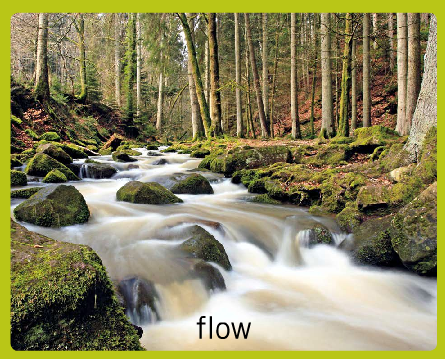
The flow is the amount of water which a river carries. 

LAKES AND RESERVOIRS

Lakes are large bodies of water surrounded by land.

Reservoirs are artificial lakes. 


We use water from reservoirs to irrigate fields and for human consumption.

WATERSHEDS IN SPAIN
Watershed where all rivers flow in to the same sea.


There are three watershed in Spain. 
CANTABRIAN WATERSHED: 
  • It has rapid and short rivers. 
  • The flow is abundant and constant.
MEDITERRANEAN WATERSHED: (Except for Ebro River)
  • It has short rivers.
  • The flow is irregular.
ATLANTIC WATERSHED:
  • The flow is abundant and fairly regular.