Utilizando las TICs para repasar, una vez terminada la unidad sobre PAISAJES, el Rios, el Clima, la fauna y la flora, trabajamos como siempre, realizamos nuestro mapa conceptual con Popplet.
Después los alumnos graban su explicación con la aplicación Screencast-O-Matic.
Publican su entrada en su Portfolio Personal creado dentro de los blogs personales de Kidblog.
Y nos lo envían para poder corregirlo a través de la red social educativa de Edmodo.
Estos son los trabajos de los alumnos de esta unidad.
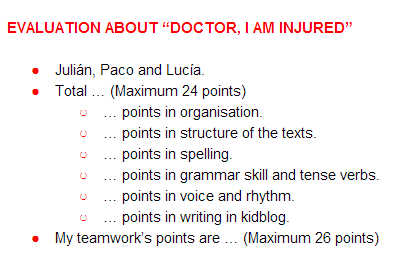
When you finish reading the rubric and you have everything clear about your mind, you can start watching your partners video and answering the questions to evaluate it. IT IS VERY IMPORTANT TO HAVE CLEAR WHAT YOU HAVE TO LOOK FOR AND WHAT ARE THE CRITERIA FOR EVALUATION.
After a term full of history lessons. We are going to investigate about the history of our area. And publish an article and create a History Magazine in the class.
The article will have five parts:
Title (It should be atractive, not just the name of the Historical period)
Historical context of the period, some short information talking about history.
Documentary about this period. (It should be an storytelling about daily life in this historical period)
Brief summary about what happened in our area(Aguilar de Campoo)
The authors and from which websites or books you took the information (the bibliography).
As we have done in all the tasks it is very important to follow the process and the following steps:
1. We will divide the class into 9 groups (most of them will be pairs and some will be threes)
Prehistory.
Preroman times.
Roman Times
Visigothics.
Muslims.
Christian Kingdoms.
Catholic Monarchs and XVI century.
XVIII Century.
XIX Century.
2. Let's review all the history posts to look for information about your history period.
(You can find the explanation and the process the students followed if you click in the link) If you click on the photos you could see the final products they have done.
In this video you will know a bit more about one of the most important characters during this century: FERDINAND VII.
THE SPANISH WAR OF INDEPENDENCE.
In 1808:
Napoleón Bonaparte, the Emperor of France, invaded Spain.
The King Ferdinand VII was forced to abdicate.
Napoleon's brother, Joseph Bonaparte, became king.
Opposition to his reign led to the Spanish War of Independence.
The Spanish parliament, or Cortes, took refuge in Cadiz. In 1812 they wrote the first modern Constitution, the Constitution of Cadiz (La Pepa).
It limited the king's power.
It stablished the right of citizens, including the vote for 25 year-old men.
THE RESTORATION OF FERDINAND VII:
In 1814 Ferdinand VII was restored as King. Initially, he did not accept the Constitution and he ruled in an authoritarian manner.
In 1820 Ferdinand VII was forced to accept the Constitution after the revolt. Three years later he was restored as an absolute monarch with the help of the French.
The political chaos in Spain caused an independence movement in the Spanish colonies in Spain.
In 1824 all the American colonies except Cuba and Puerto Rico were independent.
CONSERVATISM AND LIBERALISM:
In 1833, Ferdinand's daughter, Isabella II, came to the throne. During her reign there were conflicts between two groups:
Conservatives, they had traditional values, and supported an absolute monarchy.
Liberals, they wanted reforms to modernise the country. They supported the Constitutions, and favoured limitations on the powers of the monarch.
There were many coups d'etat by army officers and in 1868 Isabella was exiled.
In 1873, the First Spanish Republic was proclaimed, but it lasted less than a year. In 1874, the monarchy was restored under Isabella's son, Alfonso XII.
LET'S PLAY WITH THIS ACTIVITIES AND REVIEW THE LESSON.
This short video will explain to you how it was started a new period in the history of Spain:
THE SPANISH WAR OF SUCCESSION:
Charles II, died in 1700, without descendants.
Two Royal families claimed for the Spanish Throne: The French Bourbons and The Austrian Habsburgs.
As you can see in the map most of the European countries were involved in this long war, The Spanish War of Succession it lasted from the 1701 to the 1714.
Whe it ended Philip V, the French claimant, became the King of Spain. The Bourbon dinasty started and replaced the Habsburgs.
THE BOURBON DINASTY:
Philip V established the absolute monarchy. In which the monarch has all the power of the country.
Other Bourbon Kings were: Charles III and Charles IV. They introduce many reforms.
Secretaries of states were appointed to help the king with different issues such the tax collection, the administration of American territories.
To improve the economy they created small royal factories.
SCIENCE AND CULTURE IN THE 18TH CENTURY:
Science and Culture were very prominent during the 18th Century:
Academies were founded, such the Royal Academy of Language.
Daily newspapers appeared.
Many museums and botanical gardens were created.
LET'S CHECK ALL WHAT YOU HAVE JUST LEARNT ABOUT BOURBONS WITH THIS ACTIVITY.
First of all we invite you to have a look to this videos they will help you to review the main topics of this unit:
Should and shouldn't
How questions
Vocabulary about health.
And now you can spend some of your time doing this activities they will be very useful for you to check your learning and improve in case it would be needed.