Mostrando entradas con la etiqueta Year 1. Mostrar todas las entradas

miércoles, 30 de mayo de 2018

Working with real art at Year 1.

Let's have a look to the following pictures, and talk a bit with your Thinking Twin.

  • Do you know which picture is this? Can you give it a title?
  • Who is this person? Do you think is someone from our days or it lived in the past?


The men is a famous painter who lived around 1650 and the picture is "Las Meninas", one of his most famous paintings, now you can see it at Museo del Prado in Madrid. 

The following video explain you a bit more about it. Try to get at least one idea from it. 


What have you learnt about the picture?


WOULD YOU LIKE TO BECOME AN ARTIST LIKE VELAZQUEZ?

In the following worksheet you will create your own desing for the Meninas, using small pieces of paper. 


Do you know that in Madrid some artists have updated the Meninas around the streets?


Let's try to do your own design in the dress of La Menina. 

jueves, 16 de febrero de 2017

Last task for our Augmented Zoo (Natural Science - Year 1)

We are getting the end of or project so we are nearly ready to prepare the final product our Zoo, our Augmented Zoo.  First of all we are going to visit a zoo with a song, let's think on the animals we can find in a Zoo.


We are going to identify most of the animals we have watched on the video and then we will classify some of them into the following worksheet.


DESCRIBING ANIMALS


PROCESS:

STEP 1: Join your THINKING TWIN. Tell him or her which your favourite animal is.

STEP 2: Work with your THINKING TWIN. Tell him or her what you are going to write in the different part of the chart:
  • COVERING: fur, feathers, scales, moist skin.
  • BORN: Viviparous - Oviparous.
  • LIVE: in the farm, in the forest, in the sea......
  • EAT: Carnivore, Herbivore, Omnivore.
STEP 3: Think on different sentences about you animal using:
  • It is ..........
  • It has.........
STEP 4: Draw a picture about your animal in the rectangle which is in the upper part of the worksheet. 

STEP 5: Time for writing all this information little by little in you worksheet. 

STEP 6: Let's check with you THINKING TWIN everything is correct. 


When we finish we are going to record videos about our animals and create the QR codes, using the QR-code extension for Google Chrome. 

CREATING THE ZOO


Let's draw a wonderful picture of your animal and we are going to stick all of them in a big poster with all the paths and roads of the zoo. Near the picture you are going to stick the QR codes. And invite your parents to have a look to our final product. 

martes, 14 de febrero de 2017

Working Maths and Statistic at Year 1 (Project Augmented Zoo - Lesson 5)

Today in our Augmented  Zoo project we are going to work a bit of Maths and we are going to work on how to create a graph to represent the results of some questions.


We are going to investigate about pet, these are the animals that we can have at home living with us. The following song will help us to learn the vocabulary.  
  • Which animal names do you listen in the song?

Now it is time to work with our THINKING TWINS. You will have two rectangles in which you are going to record the answers of the questions. We are going to work on these questions:
  • Do you have a pet? 
    • Yes: Green square and the name. 
    • No: Red square and the name. 

  • Which is your favourite pet?
    • Dog: brown square and the name
    • Cat: grey square and the name.
    • Turtle: green square and the name.
    • Fish: orange square and the name.
    • Bird: blue square and the name. 
With your rectangles you are going to create the graph with your classmates in a big poster. 


viernes, 10 de febrero de 2017

Project: My Augmented Zoo (Year 1 - Lesson 4)

In our last task we have classigy the animalS in groups depending on what they eat and how they are born. Today we are going to classify them into six big groups.
  • MAMMALS
  • BIRDS
  • FISH
  • AMPHIBIANS
  • REPTILES
  • INSECTS
We classify them in these groups because the animals have the same characteristics. The following video will help us to learn a bit more about it. Try to catch some words.


With all the characteristics we will create a mind map to review it, we are going also to add some pictures to make it more visual. 


If you have the characteristics clear it would be time to play a bit with this game to help us to classify the animals into the different groups. 


To sum up the whole aspect we are going to work on the following worksheet. Let's identify one animal of each group of animals.


miércoles, 8 de febrero de 2017

Project: Augmented Zoo (Year 1 - Lesson 3)

In this lesson abot Animals we are going to learn about how to classify them depending on two characteristics:

  • What they eat.
  • How they are born.

First we are going to start thinking on what an animal can eat. 

Can you think on one animal and its favourite food?

The following song could help us to learn the three new words: CARNIVORE, HERBIVORE and OMNIVORE.


Also we have different groups of animals depending on how they are born. Let's check this video and try to make a small picture with the two different possibilites of an animal to be born. 


Let's practice your learning with the following game. You will enjoy a lot:

It is time to start classifying animals. We have asked you to bring some photos, or also we can make pictures if you find easily. Then you will display them in the following chart. 
If you need some examples to draw: PARROT, SHEEP, LIZARD, FROG, LION, ....

We are going to finish drawing in the following chart, you have to draw one animal of each group. It would be amazing if you write the name of it also. 

jueves, 2 de febrero de 2017

Project: My Augmented Zoo (Year 1 Primary - Lesson 2)

After learning what a living or a non-living things are, it is time to focus our attention into one of the biggest groups of living things: THE ANIMALS. 


To start with this part of our project we are going to work first our communicative skills, we are going to introduce a new question to our daily routines. 

WHAT IS YOUR FAVOURITE ANIMAL? 
My favourite animal is................

With your THINKING TWIN you are going to talk and finally you will introduce HIS or HER favourite animal. 


For describing the animals we need to know which the different parts of the body are. Do you think animals have legs, eyes, nose.......?  Yes, they have. Let's learn a bit more about the vocabulary with the following presentation.


Animal body parts de laura_paino

Now it is time to play with your Thinking Twin. Your teacher will leave some worksheets on the table with the labels, you have to label the pictures. You can only go to other table if the teacher has checked everything is correct. 


With the following book we are going to discover the different animal covering. 
  • What does an animal have around the body?
  • Do all of the animals have the same around their body?
Book titled 'Animal body coverings'

Let's practice what you have learnt about the different body coverings by labelling the different animals we worked in the previous activity. Using the words: FUR, SCALES and FEATHERS.

To sum up the whole lesson you are going to draw your favourite animal and label the main parts of it. You will also complete two  sentences. Let's use the following worksheet for that purpose. 

lunes, 30 de enero de 2017

Project: My Augmented Zoo (Year 1 of Primary School - Lesson 1)

Along this month we are going to start a new project for Year 1 at Colegio San Gregorio. It is titled: My Augmented Zoo, the final product will be a big poster in which the students will talk about their animals.

To start with we are going to start learning about things, and the characteristics of Living and Non-living things. Let's enjoy the following song and discover the three main characteristics of each group of things:


When we discover the three main characteristics we will try to use our ideas in different things classifying into groups the given flashcards, we will give reasons for each one.

In the following worksheet we are going to show our learning along this lesson. 


jueves, 4 de junio de 2015

NUESTRO ZOO AUMENTADO (Ciencias Naturales 1ºEP)

En el área de Natural Science de 1º de Educación Primaria del Colegio San Gregorio hemos llevado a cabo un PBL bajo el título: AUGMENTED ZOO.

A lo largo del mismo hemos:
  • Aprendido sobre los animales, sus características y clasificación.
  • Representado gráficamente nuestro conocimiento.
  • Descubierto lo que es y supone un código QR.
Tras haber trabajado y aprendido sobre los animales, decidimos representarlos en un mapa conceptual que nos ayudase a realizar la tarea posterior de descripción.


Después comenzamos con nuestra tarea - producto final. Teníamos que completar una ficha con las características y descripción de nuestro animal preferido.  Con nuestra ficha ya elaborada nos grabamos unos a otros describiendo nuestros animales. 


En la siguiente lista de reproducción podéis ver todos nuestros vídeos, nos esforzamos mucho para pronunciar bien y explicarnos lo mejor posible. 


Después generamos los códigos QR de cada uno de nuestros vídeos. En los siguientes documentos están todos nuestros códigos. 


Con los códigos ampliamos nuestro portafolio de lenguas, así no sólo podremos leer nuestro trabajo sino también escucharemos nuestros vídeos sobre el trabajo. Y así es cómo creamos unos pósters grandes con nuestros ZOOS AUMENTADOS: en las que a través de nuestro dibujos os ofrecemos mucha información sobre los diferentes animales. 


Por último disfrutamos probando nuestros códigos e invitamos a nuestras familias a visitar y aprender con nosotros y de nuestros trabajo.

miércoles, 25 de marzo de 2015

Los alumnos de 1º comienzan a utilizar CÓDIGOS QR

Como en cada unidad didáctica nuestros alumnos de 1º han realizado su actividad para ir ampliando su PORTAFOLIO. Un portafolio en el que los alumnos van acumulando evidencias de su aprendizaje en las áreas de Inglés y Science.

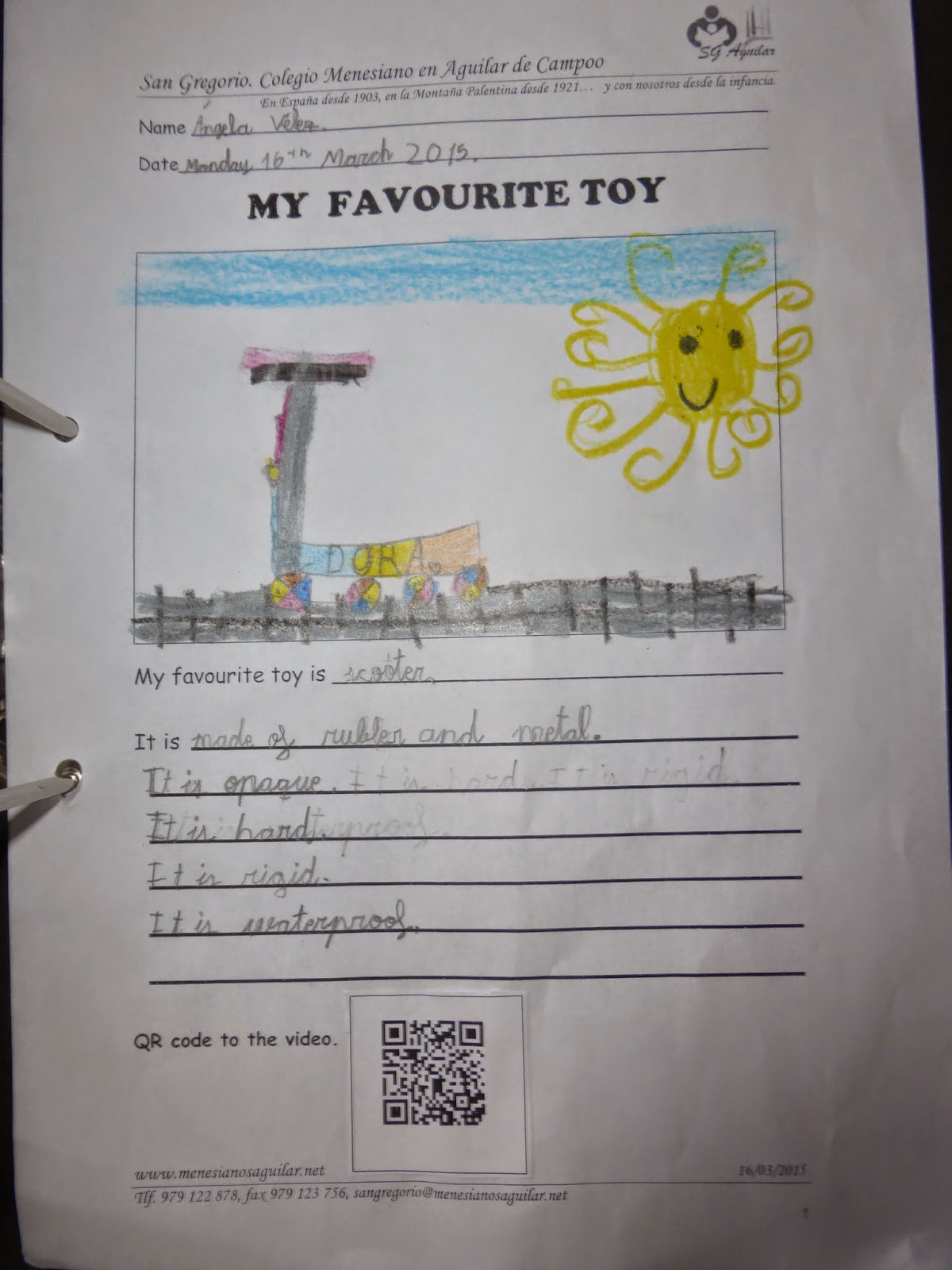
Esta vez el tema que nos ocupaba en Science eran los materiales y las propiedades de los mismos. Y en el área de Inglés trabajamos los juguetes. Así pues a los alumnos se les planteó la actividad: MY FAVOURITE TOY. La cuál realizaron con la siguiente ficha.


En la misma ficha tenían que dibujar su juguete preferido y describirle utilizando:
  • It is (y las diferentes propiedades: transparent, opaque, rigid, soft, hard, flexible, waterproof)
  • It is made of (metal, fabric, rubber, glass, plastic, leather...)
Una vez terminados los trabajos los alumnos se grabaron por parejas: uno de ellos era el cámara y el otro hablaba acerca de su juguete.


A través de nuestro gestor educativo, los alumnos de forma personal y con ayuda del profesor mandaron un mensaje a sus padres con la dirección del vídeo. 

Y esta vez quisimos tener la oportunidad de convertir nuestro portafolio de papel del aula en un portafolio digital. Que cuando volvamos sobre los aprendizajes de los alumnos no sólo leamos sino que podamos escucharles. Para ello realizamos y explicamos a los alumnos que era un código QR y para qué servía.


Cada alumno pegó un QR en su trabajo para poner en el portafolio y otro en un póster que creamos juntos para que en el pasillo del colegio la gente pueda disfrutar de su trabajo también.


Por último disfrutamos mucho probando cómo funcionan los código usando un móvil.