When you finish reading the rubric and you have everything clear about your mind, you can start watching your partners video and answering the questions to evaluate it. IT IS VERY IMPORTANT TO HAVE CLEAR WHAT YOU HAVE TO LOOK FOR AND WHAT ARE THE CRITERIA FOR EVALUATION.
After a term full of history lessons. We are going to investigate about the history of our area. And publish an article and create a History Magazine in the class.
The article will have five parts:
Title (It should be atractive, not just the name of the Historical period)
Historical context of the period, some short information talking about history.
Documentary about this period. (It should be an storytelling about daily life in this historical period)
Brief summary about what happened in our area(Aguilar de Campoo)
The authors and from which websites or books you took the information (the bibliography).
As we have done in all the tasks it is very important to follow the process and the following steps:
1. We will divide the class into 9 groups (most of them will be pairs and some will be threes)
Prehistory.
Preroman times.
Roman Times
Visigothics.
Muslims.
Christian Kingdoms.
Catholic Monarchs and XVI century.
XVIII Century.
XIX Century.
2. Let's review all the history posts to look for information about your history period.
In this video you will know a bit more about one of the most important characters during this century: FERDINAND VII.
THE SPANISH WAR OF INDEPENDENCE.
In 1808:
Napoleón Bonaparte, the Emperor of France, invaded Spain.
The King Ferdinand VII was forced to abdicate.
Napoleon's brother, Joseph Bonaparte, became king.
Opposition to his reign led to the Spanish War of Independence.
The Spanish parliament, or Cortes, took refuge in Cadiz. In 1812 they wrote the first modern Constitution, the Constitution of Cadiz (La Pepa).
It limited the king's power.
It stablished the right of citizens, including the vote for 25 year-old men.
THE RESTORATION OF FERDINAND VII:
In 1814 Ferdinand VII was restored as King. Initially, he did not accept the Constitution and he ruled in an authoritarian manner.
In 1820 Ferdinand VII was forced to accept the Constitution after the revolt. Three years later he was restored as an absolute monarch with the help of the French.
The political chaos in Spain caused an independence movement in the Spanish colonies in Spain.
In 1824 all the American colonies except Cuba and Puerto Rico were independent.
CONSERVATISM AND LIBERALISM:
In 1833, Ferdinand's daughter, Isabella II, came to the throne. During her reign there were conflicts between two groups:
Conservatives, they had traditional values, and supported an absolute monarchy.
Liberals, they wanted reforms to modernise the country. They supported the Constitutions, and favoured limitations on the powers of the monarch.
There were many coups d'etat by army officers and in 1868 Isabella was exiled.
In 1873, the First Spanish Republic was proclaimed, but it lasted less than a year. In 1874, the monarchy was restored under Isabella's son, Alfonso XII.
LET'S PLAY WITH THIS ACTIVITIES AND REVIEW THE LESSON.
This short video will explain to you how it was started a new period in the history of Spain:
THE SPANISH WAR OF SUCCESSION:
Charles II, died in 1700, without descendants.
Two Royal families claimed for the Spanish Throne: The French Bourbons and The Austrian Habsburgs.
As you can see in the map most of the European countries were involved in this long war, The Spanish War of Succession it lasted from the 1701 to the 1714.
Whe it ended Philip V, the French claimant, became the King of Spain. The Bourbon dinasty started and replaced the Habsburgs.
THE BOURBON DINASTY:
Philip V established the absolute monarchy. In which the monarch has all the power of the country.
Other Bourbon Kings were: Charles III and Charles IV. They introduce many reforms.
Secretaries of states were appointed to help the king with different issues such the tax collection, the administration of American territories.
To improve the economy they created small royal factories.
SCIENCE AND CULTURE IN THE 18TH CENTURY:
Science and Culture were very prominent during the 18th Century:
Academies were founded, such the Royal Academy of Language.
Daily newspapers appeared.
Many museums and botanical gardens were created.
LET'S CHECK ALL WHAT YOU HAVE JUST LEARNT ABOUT BOURBONS WITH THIS ACTIVITY.
When you finish reading the rubric and you have everything clear about your mind, you can start watching your partners video and answering the questions to evaluate it. IT IS VERY IMPORTANT TO HAVE CLEAR WHAT YOU HAVE TO LOOK FOR AND WHAT ARE THE CRITERIA FOR EVALUATION.
We will continue learning about how things happened in the Iberian Peninsula during the Middle Ages. Remember first were the Visigoths then the peninsula was invaded by the Muslims, and now we are going to learn how the Christians reconquested The Iberian Peninsula.
This video will show you how everything took place.
THE CHRISTIAN KINGDOMS.
The long period of expansion of the Christian kingdoms started only eleven years after the Muslins invasion. It is called RECONQUEST.
By around 1230, there were FOUR LARGE KINGDOMS:
KINGDOM OF PORTUGAL, it was independent from Leon.
KINGDOM OF NAVARRE, Navarra and La Rioja.
CROWN OF ARAGON: Catalonia Counties, Kingdom of Aragon, Valencia and Majorca.
CROWN OF CASTILE: Includes the Kind of of Castille and the Kindom of Leon. Later it included Al Anlandalus.
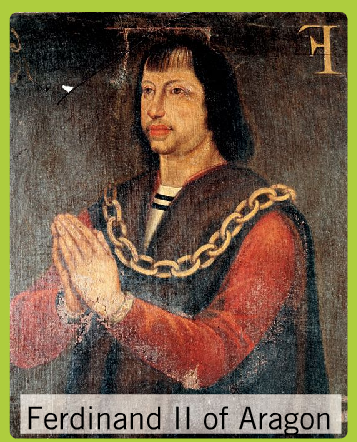
In 1479, Isabella I of Castille married Ferdinand II of Aragon, and the Crown of Aragon and the Crown of Castile were united.
MEDIEVAL SOCIETY:
There were three groups of people:
NOBLES: they were rich and they were the owners of the land.
CLERGY: They were monks, bishops and priests.
PEASANTS: It was the biggest group, they cultivated the land.
CULTURAL HERITAGE.
In the 12th Century were founded the first universities. The first one was the University of Palencia.
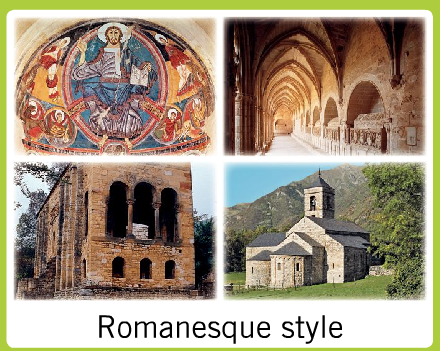
In the early Middle Ages, churches were built in Romanesque Style: thick walls and small windows.
After the 13th Century, palaces and cathedrals were built in Gothic Style. They had pinted arches and large stained-glass windows.
LET'S DO THE QUIZZ AND REVIEW ALL YOU HAVE LEARNT.
In the last historical period we talked about the Visigoths. The Visigoths were in the Iberian Peninsula until the 711 A.D. when the King Roderic was defeted by the MUSLIMS. It was in this moment when this new historical period started.
LET'S HAVE A LOOK TO THIS VIDEO TO HAVE AN IDEA ABOUT HOW THE MUSLIM CONQUEST WAS.
THE MUSLIM INVASION.
Muslims from northern Africa invaded Visigothic Spain in 711 A.D.
They ocuppied most of the Peninsula and the Balearic Islands
This territory was called Al Andalus, and its capital was Cordoba.
Al Andalus became a province of the Muslim Empire. It was governed by the caliph of Damascus in Asia.
THE EMIRATE OF CALIPHATE OF CORDOBA.
In 756 A.D. Abd ar-Rahman I established Al Andalus as an independent province or emirate.
In 929 A.D. Al Andalus became a caliphate under Abd ar-Rahman III. He was the caliph, the maximum political and religious authoroty in Al Andalus.
The caliphate lasted until 1031 A.D. During this period, Al Andalus was divided into smaller kingdoms, called taifas.
THE END OF AL ANDALUS.
The taifas fought among themselves and this helped the Christian Kingdoms to gain territory.
In 1212 A.D. The Christians defeated the Muslims at The Battle of Las Navas de Tolosa.
In 1492 A.D. the Catholic Monarchs conquered the only remaining Muslim Kingdom, the Kingdom of Granada.
SOCIETY AND CULTURAL HERITAGE.
Al Andalus society was formed by Muslims, Christians and Jews.
It had great scienctists, suchs as doctors, mathematicians and geographers. The mathematicians created the systems of numbers which we used today